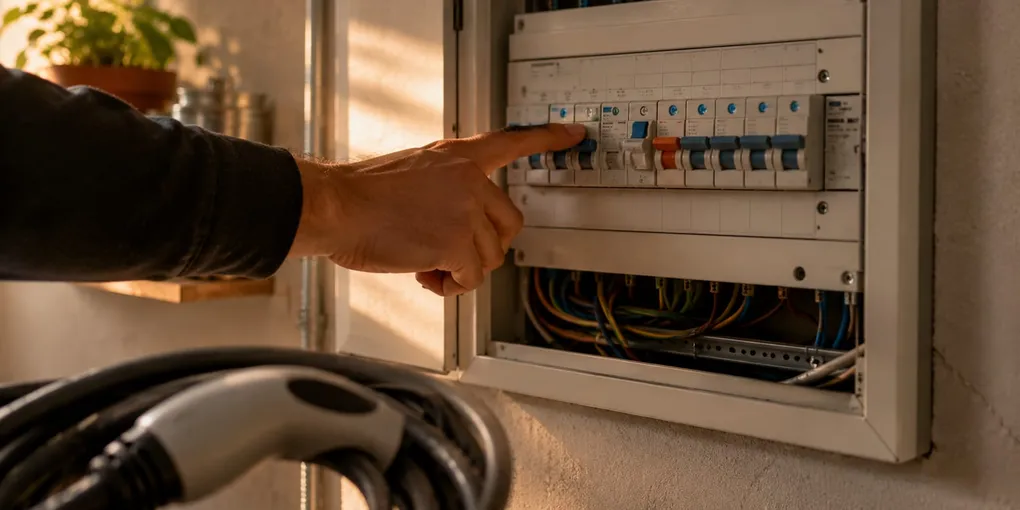
EV Charger Electrical Protection: The GFCI Breaker You Can't Skip
There’s one line on a charger quote that almost nobody reads, and it’s the only one that decides whether your setup shrugs off a fault or turns into a real problem. It isn’t the sleek unit on the garage wall or the phone app. It’s the protection hidden inside the panel. Cut it to save a hundred bucks and you’re gambling with two things that don’t forgive mistakes: a shock and a fire. The part that matters has a name: a dedicated circuit with ground-fault protection, sized under the NEC’s 125% continuous-load rule, and a properly rated breaker — and skipping it is the most expensive shortcut in the whole install.
That ground-fault piece is exactly what separates an ordinary outlet from a circuit built to charge a car. Let’s walk through it with the numbers on the table.
Why an EV charger isn’t just another outlet
A Level 2 charger pulls a heavy, sustained current for hours — that’s a “continuous load” in code language. The National Electrical Code (article 625) treats it accordingly: the circuit and breaker must be sized to at least 125% of the charger’s rated current. A 40-amp charger therefore lives on a 50-amp circuit, not a 40. Skimp on that and the breaker nuisance-trips, or worse, the wire runs hot for years.
On top of the sizing, code requires ground-fault protection for personnel on many EV circuits. That’s the safety net for the one day something goes wrong with a wet cable or a nicked wire.
Hardwired or plug-in — and where the GFCI lives
Here’s the decision that quietly moves money around your quote. A charger can be hardwired or fed from a NEMA 14-50 receptacle. The plug-in route looks cheaper until you read the fine print: a 14-50 outlet on a 240V circuit generally needs GFCI protection at the breaker, and a 50-amp GFCI breaker is not a cheap part. A hardwired unit often provides its own ground-fault detection internally, letting you use a standard breaker.
| Setup | Ground-fault protection | Typical breaker cost | Notes |
|---|---|---|---|
| Hardwired charger | Built into many units (CCID) | $15-40 standard breaker | Often the cheaper, cleaner path |
| NEMA 14-50 plug-in | GFCI at the breaker required | $100-150 GFCI breaker | Flexible, but the breaker costs 3-4x more |
| Plug-in + charger with internal protection | Redundant | GFCI breaker still typically required | You may pay for protection twice |
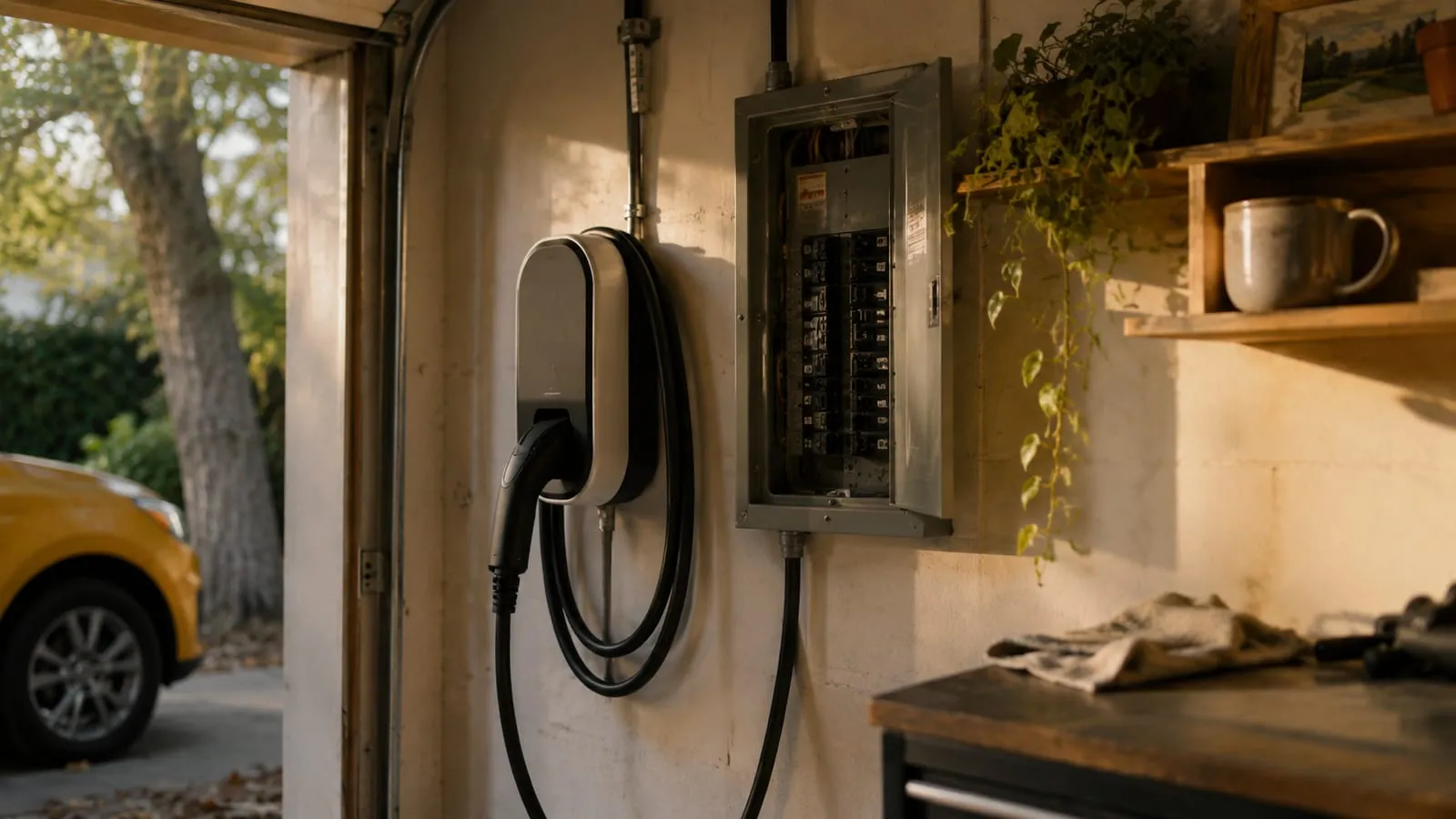
Read the last column carefully: with a plug-in setup you can end up paying for ground-fault protection twice — once in the $100-plus GFCI breaker and again in the charger’s own electronics. Hardwiring a unit that carries its own protection is often the smarter spend. I’ve seen installs with a pricey GFCI breaker feeding a receptacle for a charger that already had internal fault detection — the same protection, bought twice.
The rest of the circuit
Ground-fault protection is the headline, but it doesn’t work alone. A properly built Level 2 circuit includes:
- A correctly sized breaker, following the 125% rule. Never oversize the breaker beyond the wire’s rating to stop nuisance trips — that defeats the breaker’s job of protecting the conductor.
- A dedicated circuit. The charger shares its line with nothing else — its own home run from the panel. Hanging a charger off the dryer outlet is the amateur move that cooks conductors.
- Surge protection. A voltage spike from a storm or a utility switch can fry the charger’s electronics — and the car plugged into it. It’s rarely mandatory, but weighed against replacing a car’s onboard charger, it’s cheap insurance.
A note from someone who’s opened a lot of panels: the place people cut corners worst is wire gauge on a long run. If the charger sits eighty feet from the panel and the electrician pulls the bare-minimum gauge, voltage drop slows your charge and heats the run. Go one size up on a long pull. Copper is paid for once; the problem lasts forever.

The mistakes that cost the most
After enough installs, the same errors keep showing up:
- No permit or inspection. The AHJ (your local authority) has to permit and inspect the circuit. Skip it and your insurance may walk away from a claim — and you’ve no proof it’s safe.
- Sharing a circuit. The charger needs its own home run. Piggybacking on an existing circuit overloads it and defeats the sizing math.
- Oversizing the breaker to stop trips. If it trips, the fix is the right wire and load — not a bigger breaker that no longer protects the wire.
- Forgetting surge protection. Nobody misses it until the storm that costs them a car.
If you’re still choosing hardware, cross-reference this with how to choose a home EV charger, because the model you pick decides which protection you build in versus buy separately. And since these parts move the total, square it against the real cost of installing a charger.
When you need more current — and more protection
Don’t leave thinking protection is one-size-fits-all. A 48-amp charger needs a 60-amp circuit and heavier wire than a 32-amp unit; the protection scales with the current. Bigger isn’t automatically better, though — most homes charge fine overnight on a 40-amp circuit, and going higher just adds cost. Match the circuit to what the car’s onboard charger can actually accept.
If you’re weighing amperage, read how many amps and kW you actually need before locking in a breaker size, because that number drives the whole protection package.
Frequently asked questions
Does an EV charger need a GFCI breaker?
It depends on the setup. A NEMA 14-50 plug-in charger on a 240V circuit generally requires GFCI protection at the breaker per code. A hardwired charger often has ground-fault detection (CCID) built in, which can let you use a standard breaker. Either way, the circuit must have ground-fault protection somewhere — never none.
How much do the protections add to the install?
For a hardwired charger with built-in protection, you’re mostly paying for a standard breaker and wire — often under $50 in parts. Go the plug-in route and a 50-amp GFCI breaker alone runs $100-150. Optional surge protection adds a little more. That’s why the hardwired-versus-plug-in choice matters to your wallet.
Why can’t I just use a bigger breaker to stop it tripping?
Because the breaker protects the wire, not the charger. Oversizing it past the conductor’s rating means a fault can overheat the wire without ever tripping the breaker. If a properly sized breaker trips, the answer is correct wiring and load management — not a bigger breaker.
Can I install the charger and its protection myself?
In most jurisdictions a 240V EV circuit requires a licensed electrician and a permit with inspection. The electrician sizes the breaker and wire, provides ground-fault protection, and the inspection certifies it. Without a permit, an insurer may deny a claim after a fault.
Do I still need panel protection if the charger has it built in?
Yes, partly. Many chargers include ground-fault detection, which can simplify the breaker choice. But you still need a properly sized breaker and a dedicated circuit at the panel. The charger’s internal protection complements the circuit — it doesn’t replace it.