Installing an EV Charger in an HOA or Condo: Your Right to Charge and the Step-by-Step
Most owners assume the same thing: that a home charger in a shared garage lives or dies by the HOA board’s mood, and that a single grumpy neighbor can kill it. In much of the country, that’s simply not how it works. If you live in one of the roughly fifteen states with a “right to charge” law, your HOA cannot flat-out ban you from installing a Level 2 charger in your own parking spot — the most it can do is set reasonable conditions, and in many states its silence counts as approval after about 60 days.
That last part surprises people. In several right-to-charge states, if the board sits on your application past the deadline, it’s deemed approved by default. The clock works for you, not against you. Let’s walk through how to use that, what the board can and can’t ask for, and where people trip up.
Approval vs. a real veto: know the difference
The states that have passed right-to-charge laws include California, Colorado, Florida, Hawaii, Illinois, Maryland, New Jersey, New York, Oregon, Virginia, Washington, Connecticut, and D.C. The exact rules vary, but the spine is the same everywhere: an HOA or condo association can regulate, but cannot prohibit.
Why does that distinction matter so much? Because it flips who has to act. Without these laws, you’d be asking permission and hoping. With them, you submit a request and the board is on the hook to respond within a set window — often 60 days. Blow past it, and in many states you’re cleared to proceed.
Three things are worth nailing down before you send anything:
- You pay. The charger, the wiring, the panel work, and usually the metering and insurance are on you, not the association. That single fact defuses most objections — nobody else is footing the bill.
- The board sets conditions, not the answer. It can require a licensed electrician, proof of insurance, a specific cable route, or that you restore common areas. It can’t say “no.”
- Common-area wiring is allowed. Running a circuit through a shared wall or across a garage ceiling is normally fine, subject to those reasonable conditions.
The step-by-step process
Before you touch anything, it helps to see the whole path from first form to plugged-in car. This is the logical order:
| Step | What you do | Practical note |
|---|---|---|
| 1 | Get a quote from a licensed electrician | Have them measure the run from your panel or the meter to your spot |
| 2 | Submit a written application to the HOA | Follow the association’s architectural-request process |
| 3 | Let the clock run | If the board misses the deadline (often ~60 days), it’s typically deemed approved |
| 4 | Pull the permit | Your electrician files with the local authority (AHJ) |
| 5 | Install + inspection | Dedicated circuit, GFCI protection, then the AHJ signs off |
Notice the detail in step one: the number that blows up an EV-charger budget is almost never the charger itself — it’s the distance from the panel to your parking spot. I’ve seen two installs with identical hardware come in hundreds of dollars apart purely on wire run and conduit. If your spot is far from the electrical room, that’s the line item to scrutinize. I break it all down in the guide to what an EV charger install actually costs.
On step two: there’s no universal form, but a good application identifies you and your spot, describes the equipment and the cable route, names your licensed electrician, and confirms you carry insurance and will cover the cost. Send it the way your association’s rules require, and keep proof of the date — that date is what starts the deadline clock.
Who installs it and what protection it needs
This is not a weekend DIY project. The work has to be done by a licensed electrician, and it has to meet the National Electrical Code — a dedicated circuit sized to Article 625, the 125% continuous-load rule, and ground-fault protection. Then the local authority inspects it.
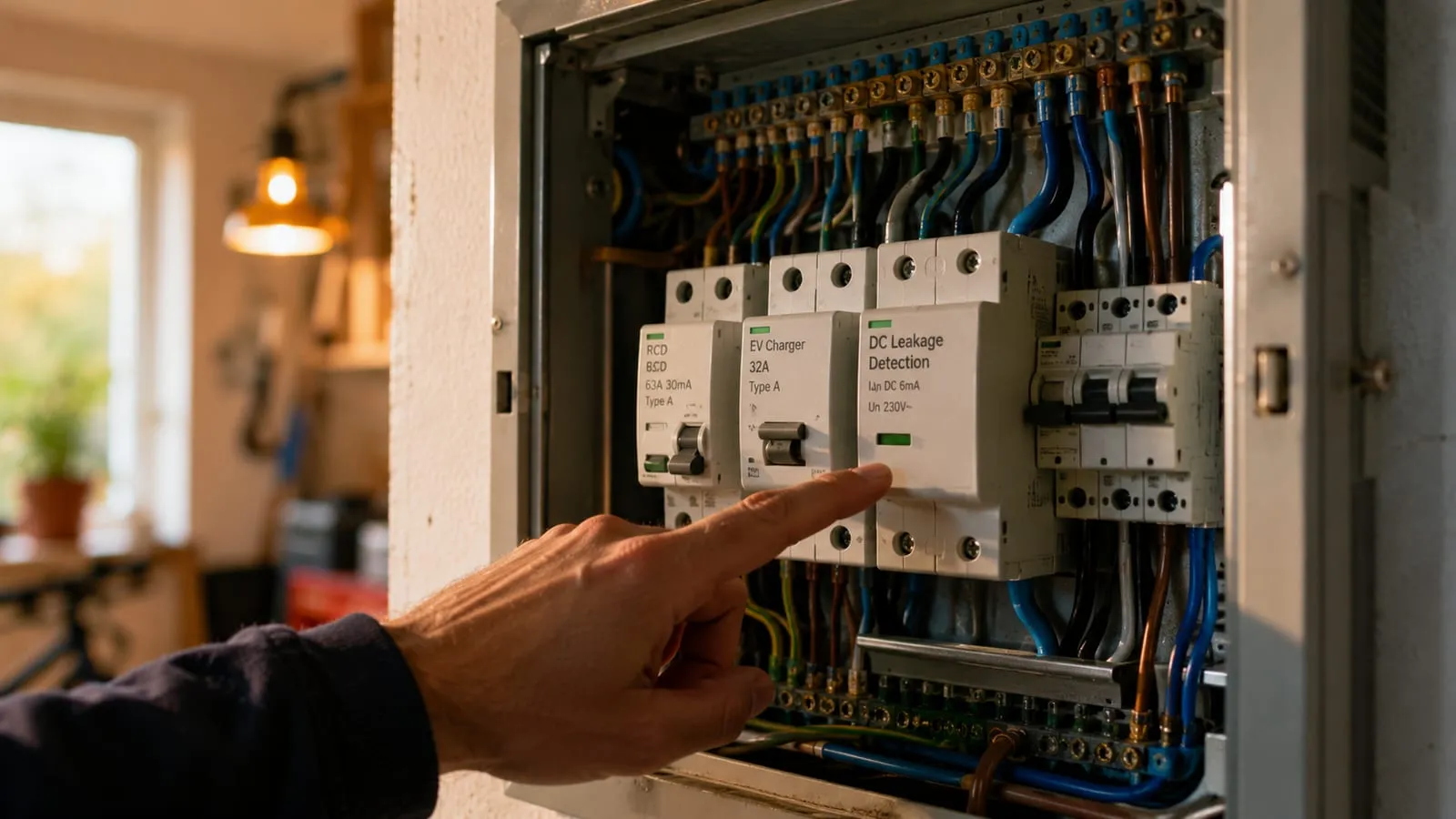
The heart of the job is a properly sized, dedicated circuit and correct fault protection. On a hardwired Level 2 install, that circuit is the difference between a safe garage and a real hazard — it’s also the part a cut-rate installer is most tempted to shortcut. If your electrician can’t explain the circuit sizing and protection off the top of their head, that’s a red flag.

Mistakes and hard-won tips
Some stumbles show up again and again:
- Treating a request like a plea. Framing it as “please, board, may I?” invites debate over something the law already settled. Submit the application, start the clock, and hold them to the deadline.
- Not documenting the submission date. In a right-to-charge state, that date is your leverage. A verbal chat at the mailboxes proves nothing.
- Skipping the permit and inspection. The cheap electrician who “doesn’t bother” with permits isn’t cheap — that’s a problem you’ve postponed, and it can bite you at resale or with a claim.
- Ignoring your panel’s headroom. If you already have heat pumps or other big loads, a charger can overload the panel. The fix isn’t always a costly service upgrade; a smart charger with load management dials its draw up and down based on what the rest of the home is using.
- Going solo when the building has a plan. In a larger complex, ask whether the association already has shared conduit or a group program. Joining it is often cheaper and cleaner than doing your own thing.
One note for the opposite situation: if you rent or don’t have an assigned spot, the path is different — and there’s more room to maneuver than you’d think. I cover it in charging an EV without a garage.
Frequently asked questions
Can my HOA ban me from installing an EV charger?
In right-to-charge states, no — it cannot prohibit a charger in your own spot. It can impose reasonable conditions (licensed installer, insurance, a set cable route), but a flat denial isn’t allowed. Outside those states you have less protection, so check your specific state law and your governing documents.
Who pays for the installation in a shared garage?
You do. The charger, wiring, protection, permit, and typically the metering and added insurance are the owner’s responsibility, not the association’s. That’s exactly why objections rarely hold up: no one else is spending money on your charger.
What if the HOA never responds to my request?
In many right-to-charge states, silence past the statutory deadline — commonly around 60 days — means the request is deemed approved and you can proceed. That’s why documenting your submission date matters so much.
How long does the whole process take?
The submission is instant. What sets the pace is your electrician’s schedule and, if applicable, the board’s response window. A straightforward install can be done within days of getting the quote; the slow part is usually booking the electrician and the inspection, not the paperwork.
Are there rebates for a charger in a condo or HOA?
The federal charger credit expired in mid-2026, but scattered state and utility rebates still exist depending on where you live. I walk through what’s left in EV charger tax credits and rebates.