Smart vs basic EV charger: dynamic load management so you never upgrade your panel
There’s a small, almost invisible accessory that decides whether you’ll overpay on your electric bill for the next fifteen years. It isn’t the priciest charger or the thickest cable: it’s a clamp that hugs your home’s incoming service wire and tells the charger how much current is still free at any given moment. With it, a 7.4 kW car and a 3 kW heat pump coexist on a modest service without tripping anything. Without it, the “easy” fix an installer offers is upgrading your panel or your service — and that’s a cost that lands every month, forever. Dynamic load management typically saves you the equivalent of $200-400 a year in avoided demand and service charges, and that saving never expires.
The whole difference between a basic charger and a smart one plays out right here. Let’s look at what load management is, how that sensor pulls it off, and why spending a bit more up front is usually the best-value decision in the entire install.
What dynamic load management actually is
Your home has a service limit: the maximum amps your panel and utility feed can carry at once before a breaker trips. An EV is, by a wide margin, the hungriest thing you’ll ever plug in — 7.4 kW on its own, more than the oven, cooktop and water heater running together.
The trouble shows up when the car overlaps with everything else. You start a dryer, the heat pump kicks in to warm the house, someone switches on the range… and the total blows past your capacity. The breaker doesn’t negotiate: it trips, and you’re in the dark mid-dinner.
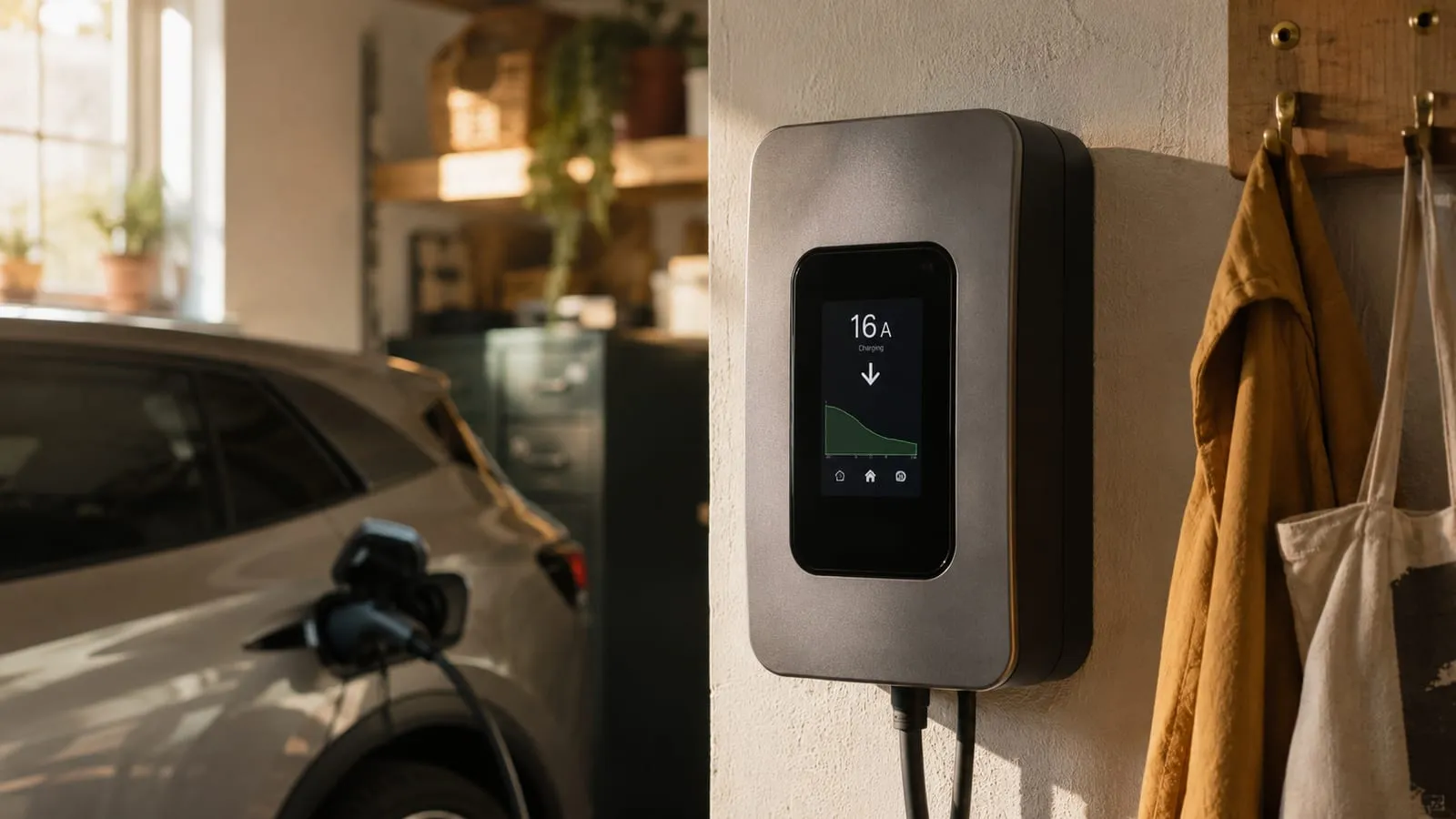
Dynamic load management — dynamic load balancing, DLB — solves this quietly. The charger doesn’t always pull flat out: it measures what the rest of the house is drawing in real time and adjusts the power it hands the car to fill only the headroom that’s left. When the house is drawing hard, the car charges slowly. When things switch off, it speeds up. It never crosses your ceiling.
In plain terms: you can run a car and a heat pump on the panel you already have. That’s the whole point.
How the CT clamp works, the piece that matters
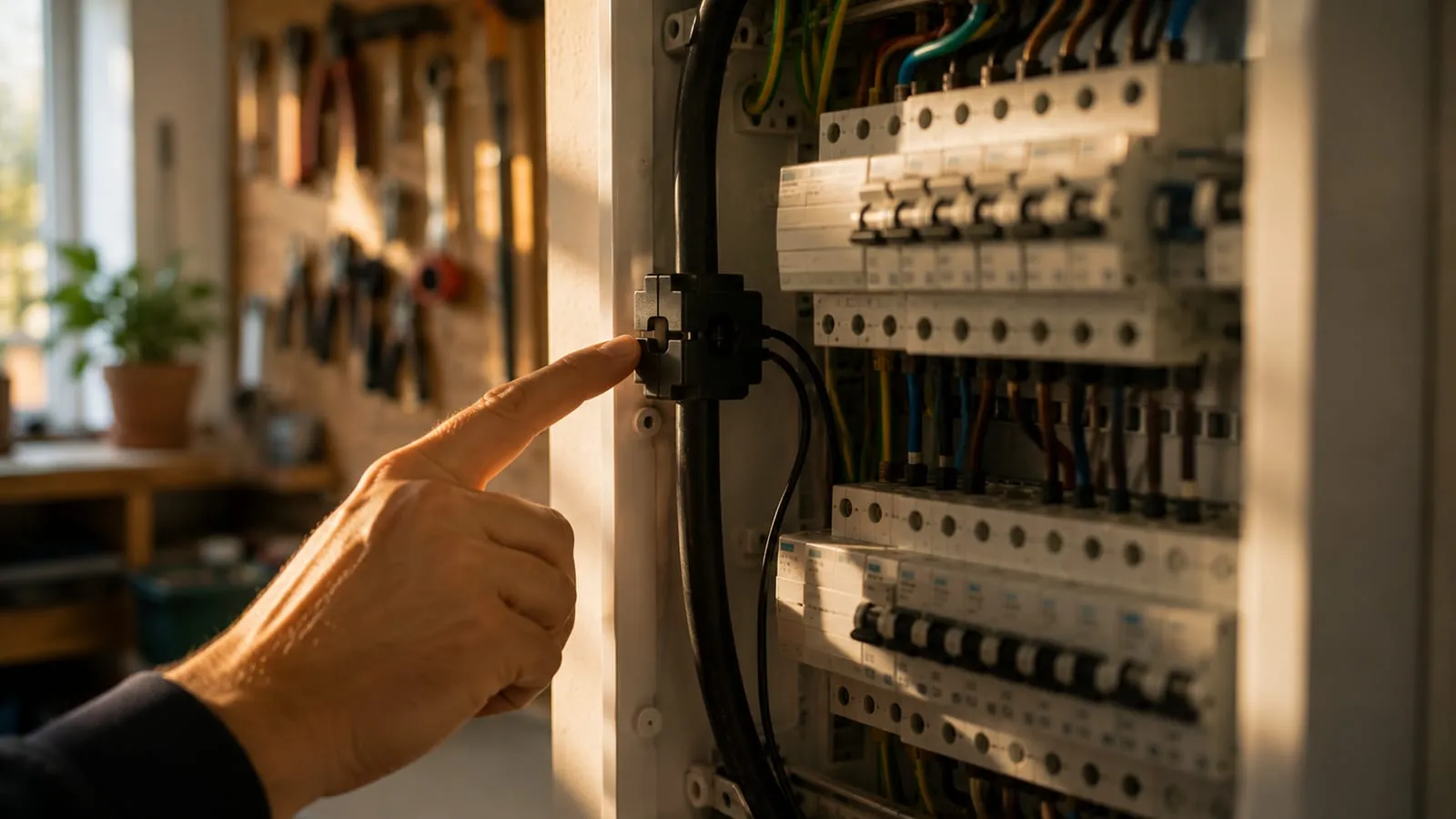
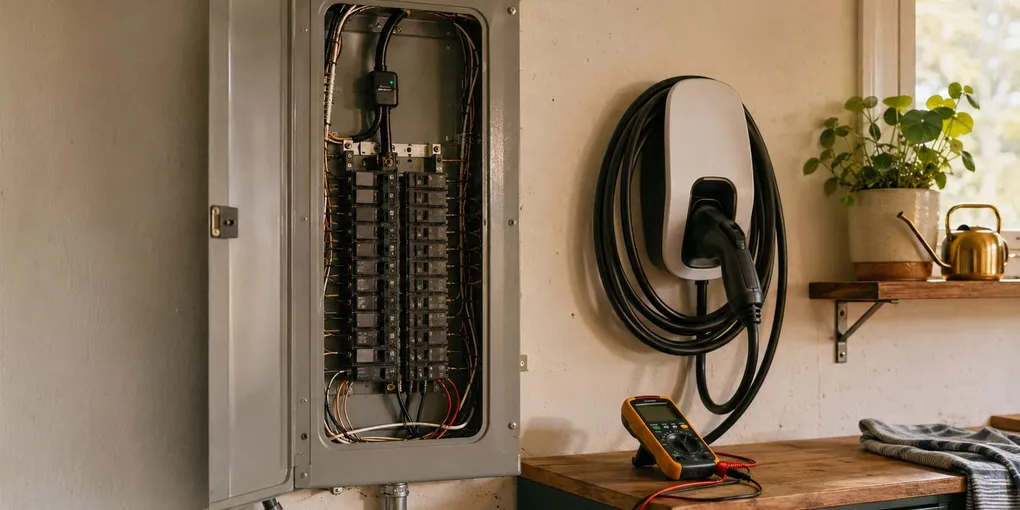
The brain of load management is a cheap sensor with an ugly name: a CT clamp (current transformer). It’s a ring that snaps around the main service conductor, right where power enters your home. It cuts nothing and touches no wire: it reads the magnetic field the current produces and, from that, knows every second how many amps the whole house is drawing.
That reading travels to the charger, which does one simple, constant subtraction: service limit minus what the house is using equals headroom for the car. With that headroom it modulates the charge between 6 and 32 amps, which on a single-phase feed is 1.4 to 7.4 kW. Six amps is the technical floor set by the standard; below it, the car won’t accept a charge.
Here’s the observation that comes from opening a lot of panels: a CT clamp in the wrong spot throws off the entire balance, and almost nobody catches it until the breaker trips. If the clamp sits downstream of a subpanel, or with the current-direction arrow reversed, or hugging just one leg in a split-phase or three-phase home, the charger “sees” a false load. Sometimes it thinks the house is empty when it’s maxed out — and then it does trip — and sometimes it thinks the house is saturated when it isn’t, and it crawls the car along for no reason. Fitting the sensor takes five minutes; fitting it right is what separates a working system from an expensive ornament.
Basic vs smart: what you pay, what you get
A basic charger plugs in and delivers whatever it can, full stop. It has no idea what the rest of the house is doing. To keep that from tripping the panel, your installer gives you one of two fixes: upgrade the service (a fixed monthly cost for life) or cap the charger at a low fixed power (you always charge slowly, even at 3 a.m. with the house empty).
A smart charger avoids both. This table sums up the real difference, past the brochure:
| Basic charger | Smart charger (with DLM) | |
|---|---|---|
| Power management | None: delivers its max | Modulates 6-32 A to fit headroom |
| Coexisting with a heat pump | Forces a service upgrade or a low cap | Shares power, no upgrade |
| Panel/service upgrade needed? | Usually yes | Almost never |
| Off-peak scheduled charging | Rarely | Yes (uses the cheap window) |
| Consumption monitoring | No | Yes (app, kWh, cost) |
| Updates and new features | No | Yes (over the air) |
| Purchase premium | — | ~$150-350 |
Read the last row against the first and third: the premium for the smart model is a one-time $150-350; what it avoids — upgrading your service — is a charge you pay every month for as long as you live there. In most homes it pays for itself in the first year or two, and after that it’s pure saving.
Living with a heat pump and an all-electric home
This is where load management goes from “handy” to essential. A home that really electrifies — a heat pump for heating and hot water, an induction cooktop, and now the car — stacks up three or four big loads that used to run on gas or gasoline.
A heat pump typically draws 2.5 to 3 kW when the compressor is working hard, and it does that exactly when it’s coldest — which is often the same moment you get home and plug the car in. Without management, that overlap is what pushes you into a bigger service. With load management the charger yields: while the heat pump is heating, the car drops to 6 amps and waits; when the compressor rests, the car recovers. The car always charges overnight, has hours to spare, and nobody minds if it runs slower for a few minutes.
If you also have solar or a battery, the next tier is a home energy management system (HEMS) that orchestrates everything under one logic: SolarEdge Home, Huawei FusionSolar, the open-source evcc, or Modbus integrations with Homey or Loxone. There the system decides, moment to moment, who gets fed first — house, heat pump, car, battery — based on sun and price. If you’re coming from the heating side, the heat pumps silo shows how this all-electric home fits together and why service capacity is the shared resource you have to manage.
The other things a smart charger gives you
Load management is the heavyweight reason, but it doesn’t travel alone. A connected charger adds things a basic one can’t:
- Off-peak scheduled charging. You tell it “charge only between midnight and 8 a.m.” and you catch your plan’s cheap window without getting up to plug in. On a car that covers 12,000 miles a year, shifting the charge off-peak is one of the biggest, easiest savings there is.
- Real monitoring. You see how many kWh you put in, what it cost, and when. It stops being an invisible line on the bill.
- Solar surplus management. With panels, many smart models charge on the roof’s leftover output (covered in depth in the solar article).
- Over-the-air updates. New features, compatibility with dynamic rates or with your car, without swapping hardware.
None of this exists in a charger that only opens and closes the flow of current.
Mistakes that kill load management (and how to dodge them)
- CT clamp in the wrong place. Mistake number one. The clamp goes on the main service feed, upstream of everything, the right way round, and on every leg in a split-phase or three-phase home. Misplaced, the balance lies.
- Buying smart and skipping the sensor. The load-management feature doesn’t exist without the CT clamp or a meter. Buying the expensive charger and leaving the sensor “for later” is money wasted: until it’s in, you charge like you would with a basic model.
- Trusting the app and not setting the limit. Load management needs your exact service capacity to do the subtraction. Enter it wrong and it either under-protects (the breaker trips) or over-protects (you charge slowly for no reason).
- Upgrading the service “just in case” before testing the balance. That’s precisely the cost the smart charger came to avoid. Install first, measure for a few weeks, and you’ll find you rarely touch the ceiling.
- Ignoring how your utility bills capacity. The value of avoiding an upgrade depends on your local demand and service charges, and those vary. Look at your own bill before you decide.
One note from having seen it fail: if the moment you start charging the car the heat pump stops kicking in, or the charge is inexplicably slow, don’t swap the charger yet. Nine times out of ten it’s the CT clamp — position, direction or a loose leg. Reseat it in five minutes and the system comes back to life.
Frequently asked questions
What exactly is dynamic load management on a home charger?
It’s the charger’s ability to measure the rest of the home’s consumption in real time and adjust the power it gives the car so the total never exceeds your service capacity. In practice the car charges fast when the house is drawing little and slows when other appliances are running, without tripping a breaker.
Do I need a panel or service upgrade to install a charger?
With a load-managing charger, almost never. The system lets the car coexist with the rest of the house, heat pump included, within the capacity you already have. Upgrading is the easy way out of a basic charger, and it’s a charge you pay every month for good.
Can I charge the car and run the heat pump at the same time?
Yes, and that’s exactly the case load management solves. When the heat pump draws hard, the charger yields power and charges the car more slowly; when the compressor rests, the car speeds up. Since the car charges overnight with hours to spare, you never notice.
Is it worth paying more for a smart charger?
In most cases, yes. The purchase premium is a one-time $150-350, and what it avoids — a service upgrade — is a permanent monthly charge. Add off-peak charging, monitoring and updates on top. It pays back in one to two years.
Which chargers have dynamic load management?
Most connected models offer it, almost always with a metering accessory: Wallbox with its Power Boost, Easee with the Equalizer, Zaptec Sense, the go-e Controller or the myenergi ecosystem (zappi with eddi and libbi). The essential part is installing the CT clamp or meter on the service feed; without that sensor the feature doesn’t work.
Before you settle on a model, get clear on how much power you actually need: see 7.4 vs 11 vs 22 kW and single vs three-phase and, if you’re still choosing, how to pick a home EV charger. And if you have a solar roof, read charging your EV with solar panels, where the same sensor pulls double duty.