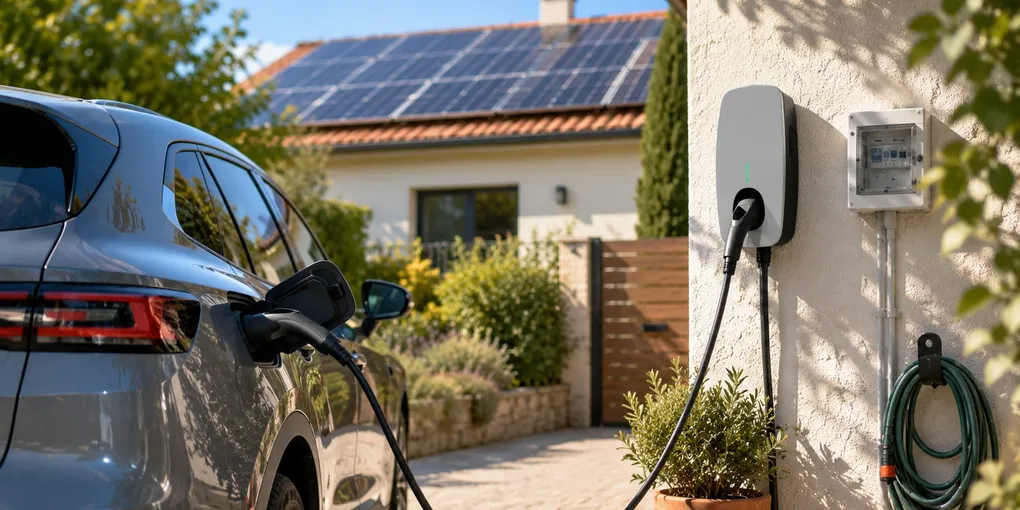
Charging Your EV With Solar Panels: How It Works and the Real Savings
It sounds like a done deal: the sun hits the roof, the car plugs in, and the miles roll in for free. And partly they do. The catch hides in one detail almost nobody mentions. If your charger is “dumb” — it kicks in at whatever hour you set it and pulls whatever power it likes — you’ll charge overnight, when the panels are asleep, paying grid electricity while you picture yourself running on sunshine. The numbers are stubborn: with no battery and no surplus management, you only actually use 30-40% of what your panels produce; add a battery and smart charging and that jumps to 60-70%.
That gap changes everything, and it’s why two neighbors with identical arrays end up with very different savings. Let’s unpack where the real savings come from, how much panel you need, and the one mistake that wrecks the math.
Why a “dumb” charger pulls from the grid even in full sun
The problem isn’t the sun — it’s the choreography between what you make and what you use. Panels peak at midday, exactly when the car is usually out. And the cheap charging window on most tariffs falls in the small hours, when there isn’t a single photon. Set the charger for 3 a.m. “because it’s easy” and your car will never see a watt from your own roof.
Here’s the field observation that saves grief: plenty of people fit panels convinced they’ll charge the car 100% from them, then plug in at night out of habit. The two systems work beautifully on their own and never talk to each other. The midday surplus gets exported to the grid at bargain rates, and after dark you buy that same energy back at full price.
A smart charger with surplus control ends that divorce. It reads, in real time, what your production has left over and modulates the car’s charge to soak up exactly that. To do it, it has to see the whole house, which means a meter or current-transformer clamp (CT): the Wallbox Power Meter, an Easee Equalizer, a myenergi CT, and so on. Tesla, to charge on solar surplus, requires a Powerwall.
Solar charging modes: pure vs hybrid
Not all “solar modes” do the same thing, and picking wrong is the second-biggest source of disappointment.
- Pure solar (surplus only): the car charges only on the excess. A cloud drifts over, the charge pauses. Maximum savings, but a gray day can leave you half-charged.
- Eco / hybrid: it uses the surplus and, when that drops, tops up from the grid to a floor you set. Less purist, but you get morning miles guaranteed.
There’s a technical floor worth understanding here: the minimum charge is 6 amps (per IEC 61851), which works out to about 1.38 kW on single-phase and 4.14 kW on three-phase. In plain terms: if your supply is three-phase and you only have 2 kW of surplus sun, an ordinary three-phase charger won’t even start, because it can’t reach the minimum. That’s why the best self-consumption units switch automatically between 1 and 3 phases (Fronius Wattpilot, go-e Gemini, Huawei, SMA, Zaptec): they start single-phase at 1.38 kW on weak sun and jump to three-phase as production climbs.
What you actually save (and what not to confuse it with)
Time for some honesty, because inflated figures get thrown around. The saving from charging on solar versus charging from the grid — comparing kWh against kWh — is more modest than the sales pitch. The reason is simple: your self-consumed, amortized solar electricity costs between $0.03 and $0.06 per kWh, while the grid runs from $0.16 to $0.38 depending on region. The gap is real, but a car doesn’t burn enough kWh for it to be spectacular on its own.
The table below separates what almost nobody separates: the solar-versus-grid saving (the one that matters if you were going to own an EV anyway) and the extra panel capacity you need to cover it.
| Region | Solar vs grid saving ($/yr) | Base home array | Extra kWp for the car |
|---|---|---|---|
| Low-tariff state | ~$240 | 5-8 kW | +2-4 kW |
| Mid-tariff state | ~$500-700 | 5-8 kW | +2-4 kW |
| High-tariff state | up to ~$1,150 | 5-8 kW | +2-4 kW |
Note the nuance that heads off disappointment: these are savings against the grid, not against gasoline. Compared to a tank of fuel the numbers get far bigger (well into four figures a year), but that’s the saving from driving electric, not from adding panels. Blend the two and you’ll convince yourself the panels pay for themselves in two years — they don’t.
How much panel the car needs
The rule of thumb: an average home is covered by 5-8 kW. To fold the car into the equation, add 2-4 kW, putting a full setup around 7-12 kW. The math comes from a car using 16-18 kWh per 100 km (roughly 260-290 Wh per mile); someone driving 8,000 miles a year needs on the order of 2,000-2,200 kWh, and that extra couple of kW produces it comfortably across most of the year.
But producing isn’t self-consuming. Without a battery, that midday surplus is lost if the car isn’t plugged in right then. That’s why the combo that genuinely moves you from 30-40% to 60-70% is a home battery plus smart charging: the battery banks the midday sun and the charger releases it when the car comes home. Miss either half and the saving stays stuck at halfway.
Mistakes that wreck the savings (and how to dodge them)
- Plugging in at night “out of habit.” The classic. With panels, the charge has to land at midday or route through a battery. Scheduling 3 a.m. cancels the roof entirely.
- Buying a home charger with no meter. Without a CT or meter the charger has no idea how much surplus exists and can’t modulate. The “solar” feature on the box doesn’t exist without that sensor.
- Three-phase supply with a charger that won’t phase-switch. If it can’t drop to single-phase, it throws away every small surplus from mornings and late afternoons.
- Expecting to charge 100% on sun. In winter, with short days and the car away, a good chunk of the charge will come from the grid anyway. Panels shrink the bill, they don’t erase it.
- Not sizing the extra panel. Add the car without adding kW and you steal sun from the rest of the house (heat pump included), and the balance gets worse.
A trick from those who’ve lived it: before spending on a battery, run a few months on daytime smart charging alone — weekends and work-from-home days. You’ll see how much surplus you truly catch and decide on the battery from data, not hope.
Frequently asked questions
Can I charge the car on solar alone, with nothing from the grid?
In theory yes, in practice almost never. You’d need a big battery, always-daytime charging, and generous production year-round. In winter, with short days and the car often out at midday, part of the charge will come from the grid. The realistic goal is covering a high fraction in summer and rather less in winter.
Is a battery worth it just for charging the car?
It depends on your routine. If the car is out all workday, the battery is the only way to store midday sun for the evening charge — that’s what lifts self-consumption from 30-40% to 60-70%. If you work from home and can plug in at midday, daytime smart charging may be enough and the battery becomes a luxury.
Which charger works for solar surplus charging?
Any one that accepts a consumption meter and has a surplus mode: Wallbox, Easee, go-e, Fronius Wattpilot, Huawei or SMA, among others. The key is the sensor (CT or meter) at the supply and, if your home is three-phase, a unit that switches between 1 and 3 phases. Tesla needs a Powerwall for solar charging.
How many panels do I add for the car?
As a reference, 2-4 kW on top of the home’s base array, for a total of 7-12 kW. That covers roughly 2,000 kWh a year of driving without stealing sun from the rest of the house.
What if I have a heat pump as well as the car?
Then smart management stops being a luxury. With a charger that does dynamic load balancing and an energy manager, you split the sun between car, heat pump and house without tripping your main supply. If you’re coming from the heating side, the heat pumps silo shows how the all-electric home fits together.
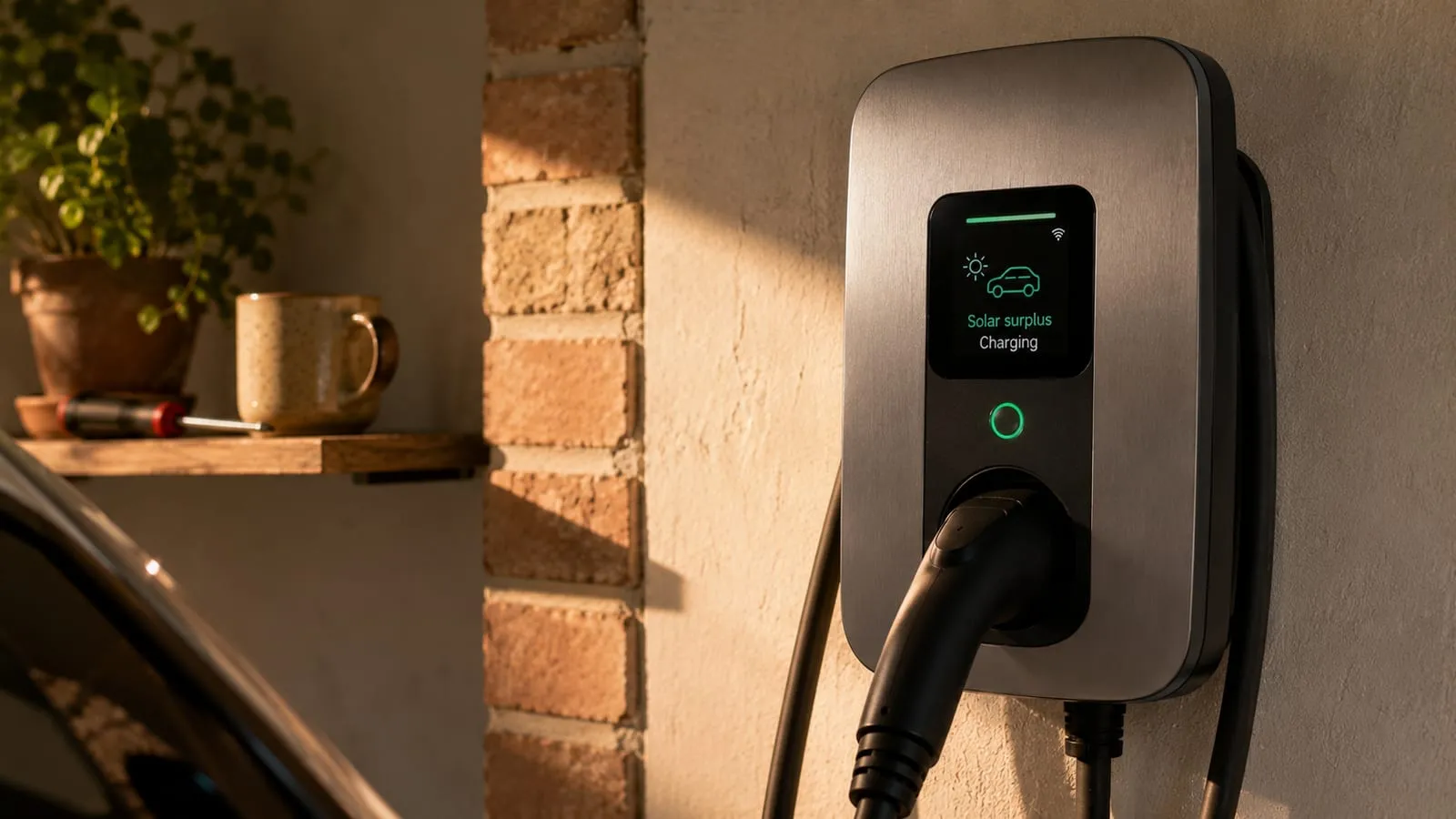
Before you decide, get clear on which charger suits your roof: run through how to choose a home charger and, if it isn’t installed yet, what it costs to fit one.