Can You Charge an EV on a Regular Outlet? Risks and When It Makes Sense
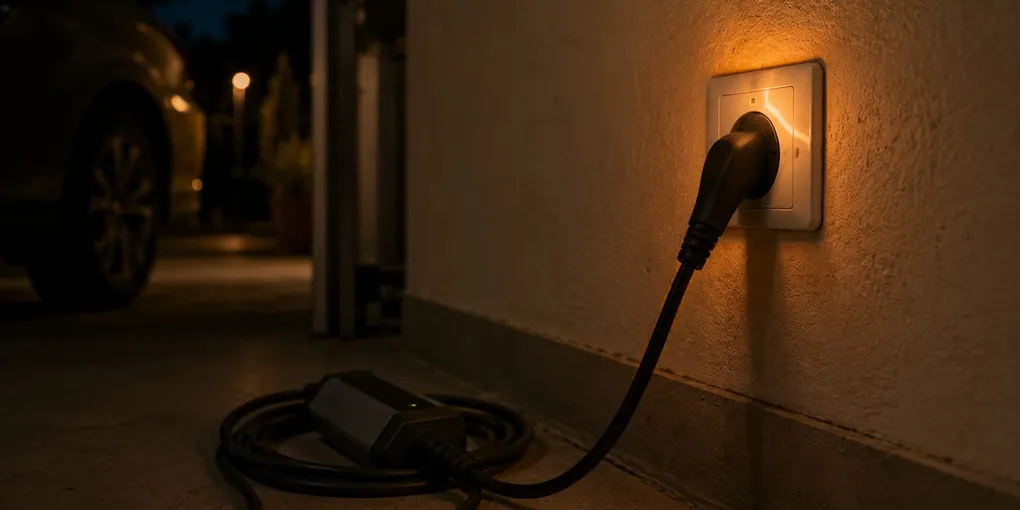
It’s three in the morning and there’s an outlet working alone on the garage wall. It has been pushing current for eight hours straight, car plugged in, and the faceplate is warm. Too warm. Nobody’s looking, because everyone’s asleep, and that’s exactly the problem: an ordinary household outlet was never built to deliver around 2.3 kW for twenty hours at a stretch, and that’s where the contact, the wire, and sometimes the box buried behind the drywall start to heat up. It rarely fails in a movie-style flash. It degrades slowly, night after night, until one day there’s a smell of hot plastic.
Charging this way is possible. The car allows it, and it ships with the “emergency” cordset for exactly this purpose. The real question isn’t whether you can. It’s when it makes sense and when you’re playing with fire, almost literally.
What actually happens when you plug the car into the wall
Level 1 charging runs off a standard 120V outlet, and that circuit is rated for occasional loads: the toaster, the vacuum, a hair dryer for a few minutes. Charging a car is a different animal. It’s a continuous load that can stay on for twenty hours or more, and for safety the portable cordset limits current to about 10 A continuous, roughly 2.3 kW at 120V.
That’s not much power over a very long time. On a mid-size battery, you’re looking at 20 to 24 hours for a full charge from nearly empty. And here’s the part almost nobody spells out: it isn’t the amperage that kills the outlet, it’s the duration. A slightly loose contact or an aging receptacle has a small resistance; with a toaster, that hot spot lasts five minutes and nothing happens. With the car, that same spot is shedding heat all night long. The heat doesn’t leave. It builds.
So the weak link is never the car or the listed cordset. It’s whatever was already in your wall: a twenty-year-old outlet, a power strip, an extension cord, or a circuit shared with the fridge and freezer.
The mistake that starts the most fires: extension cords and power strips
If you take one line from all of this, take this one: the cordset plugs straight into the wall, never through an extension cord, a power strip, or an adapter. It’s the most common failure and the most dangerous.
A coiled extension cord dissipating 2.3 kW for hours is a resistor wrapped in its own heat. A power strip multiplies the loose contact points. And a circuit shared with heavy appliances can trip the breaker in the best case or overload the wiring in the worst. Level 1 charging is only reasonably safe on a dedicated circuit, with wiring in good shape and a tight receptacle.
I’ve seen receptacles melted on the inside with the faceplate looking untouched on the outside. The plastic around the terminal softens, the contact loses its grip, resistance climbs, heat climbs more. It’s a spiral. And it happens exactly where you’re not looking.
Level 1, a reinforced outlet, or Level 2: the honest comparison
Between the plain wall outlet and a full Level 2 charger there’s a middle ground most people skip. Before the table, a warning: all three “work,” but they cover very different needs. Watch the time row and the safety row especially, because that’s where the truth shows.
| Standard 120V outlet (Level 1) | NEMA 14-50 (240V, plug-in) | Level 2 wall charger | |
|---|---|---|---|
| Power | ~2.3 kW (10-12 A) | up to ~9.6 kW | 7-11 kW |
| Full charge time | 20-24 h | ~5-8 h | 4-8 h |
| Safety | Low if the circuit isn’t dedicated; overheating risk | Medium-high: dedicated 240V line | High: dedicated circuit + EV-specific protection |
| Rough cost | $0 (use what’s there) | $300-800 installed | $800-2,500 turnkey |
| When it makes sense | Low daily miles or a temporary fix | Moderate miles, no hardwired unit | Daily use, fast and safe |
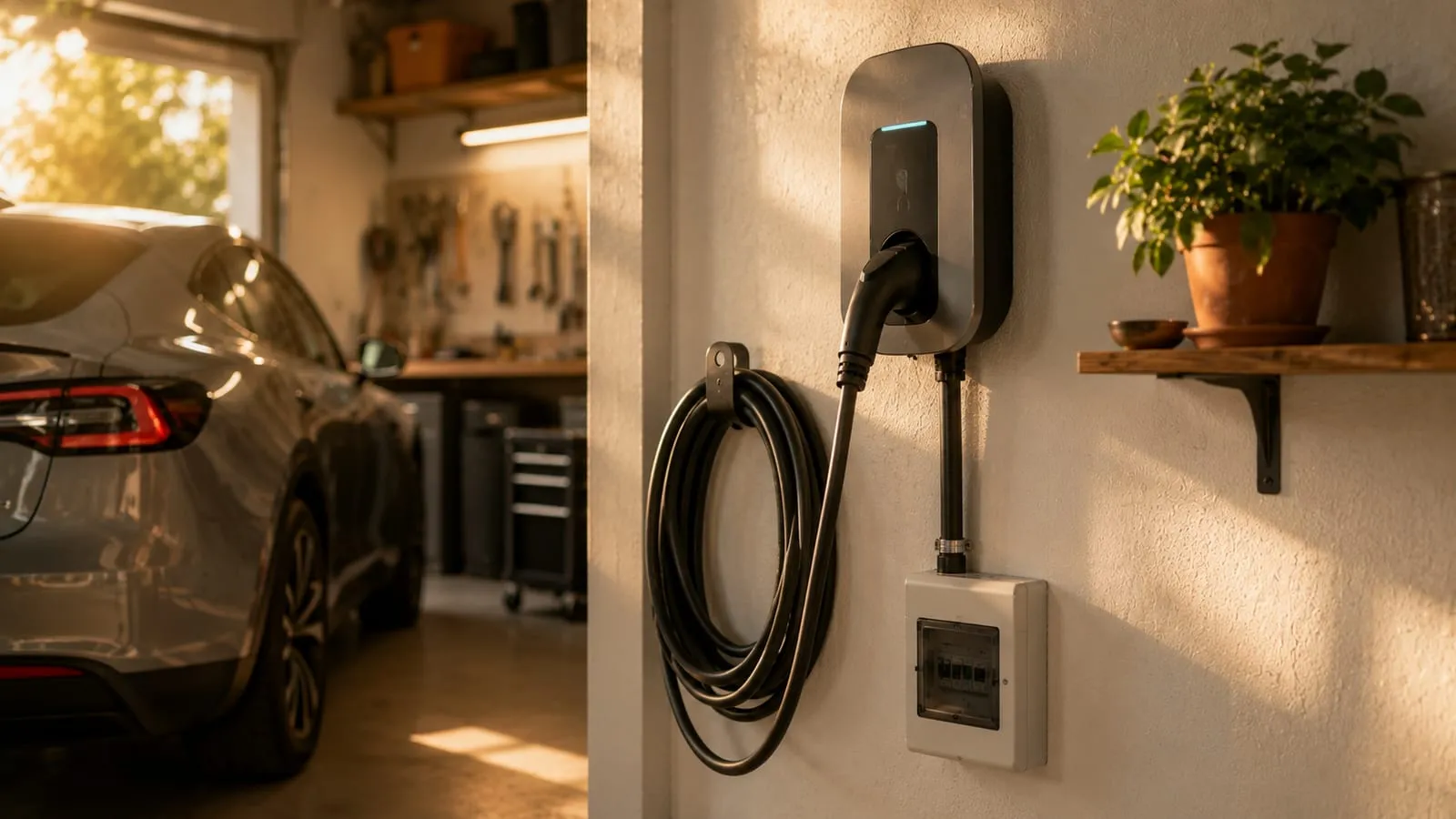
The read is clear: Level 1 is free but slow and unsafe if your wiring isn’t ready; a 240V NEMA 14-50 outlet is a solid, cheaper step up; and a hardwired Level 2 unit is the only one that combines speed, safety, and peace of mind for daily driving. Which one fits comes down to how far you drive, not how much you want to spend.
When charging on a regular outlet actually makes sense
It isn’t all alarm. Level 1 at 2.3 kW has its place, and it’s bigger than it looks.
If you drive few miles a day — say a short city commute — you might use 3 or 4 kWh daily. That comes back in a couple of hours plugged in, no strain at all. For that profile, Level 2 can be overkill. Leave the car plugged in overnight and you wake up with what you need.
It also makes sense as a temporary fix: the first few months with the car while you sort out the permanent install, or at a relative’s place over a weekend. What doesn’t make sense is turning the stopgap into a lifestyle. Plugging a car that needs long, full charges every single day into a household outlet is asking it to do something it was never designed for.
If that second profile is you — long charges, daily — the conversation changes and it’s time to look seriously at a fixed install. That’s when it pays to review how to choose a home EV charger before buying anything.
The concrete risks, and how to avoid them
Here are the real hazards in a short list, because they’re worth keeping straight:
- Overheating of the outlet and box. The most common one. Avoided with a receptacle in good shape, tight, on a dedicated circuit. If the faceplate feels hot, stop charging.
- Extension cords and power strips. Off-limits for charging. Straight to the wall, always.
- Shared circuit. Charging off the kitchen or appliance line overloads the wiring. Charging needs its own line.
- Old or undersized wiring. An aging install with tight conductor sizes doesn’t handle a continuous, hours-long load well.
- No proper protection. A well-built charge point has its own GFCI and breaker sized for the job; a bare wall outlet does not.
That last point matters more than it seems. An EV charger calls for specific protection a common outlet just doesn’t have; if you’re going to charge seriously, it’s worth understanding what electrical protection you need, because that’s what turns a dangerous line into a safe one.
The middle step: a 240V outlet
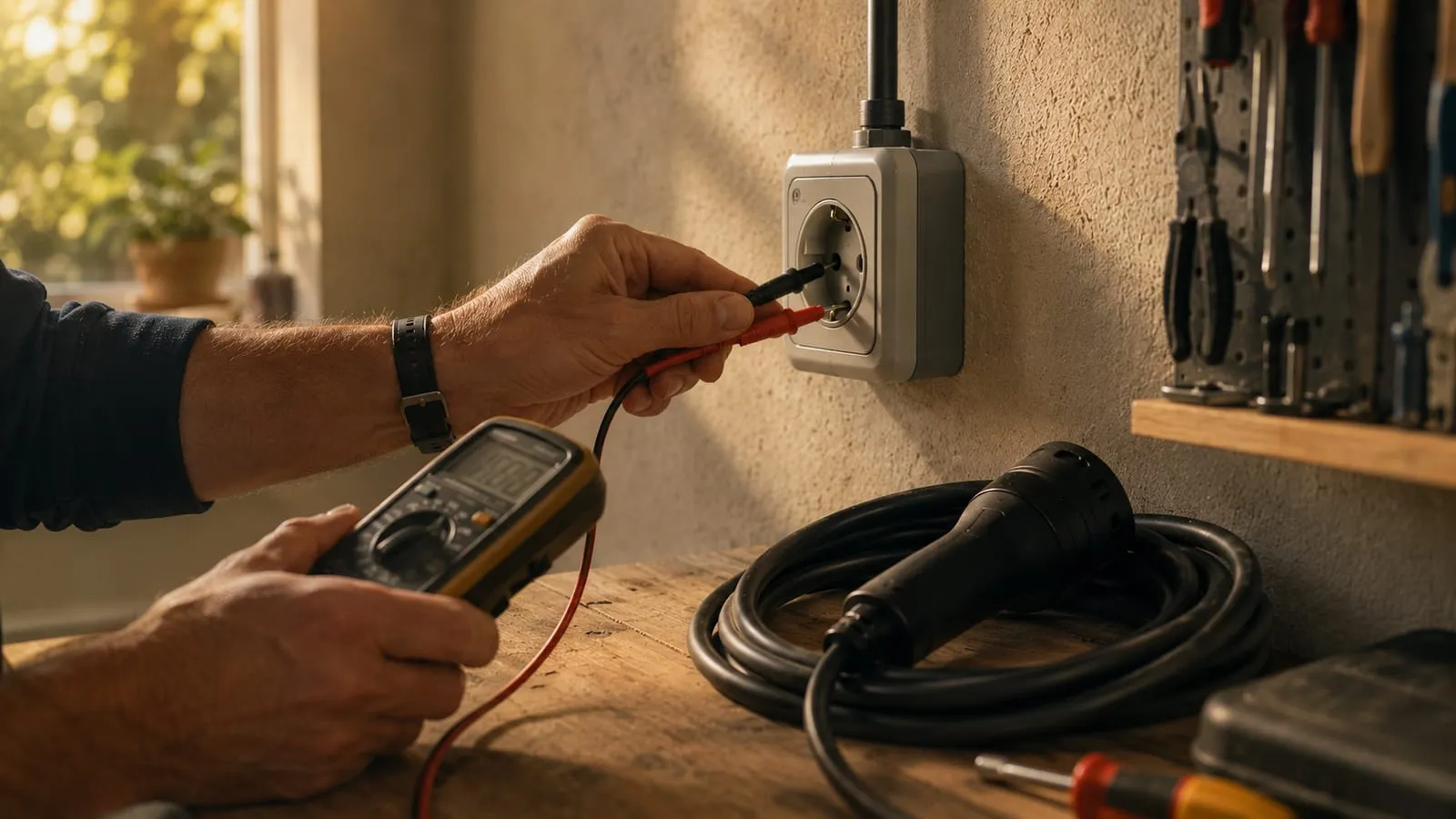
If a hardwired Level 2 unit stretches the budget but the 120V outlet makes you nervous — as it should — a 240V NEMA 14-50 outlet is the middle path. It’s a proper high-power receptacle on its own dedicated, protected circuit. It pushes power up to roughly 9.6 kW with a plug-in EVSE, cutting charge time by more than half, and it kills the underlying problem: your car no longer hangs off an improvised setup.
It costs a good bit less than a fully installed hardwired charger, and the safety jump over a bare 120V outlet is enormous. It isn’t quite as tidy as a wall-mounted unit and it doesn’t do load management, but for many homes it’s the sweet spot between price and peace of mind. When you compare numbers, look at the real cost of a Level 2 install too. Sometimes the gap is smaller than you fear and the jump is worth it.
Frequently asked questions
Is it safe to charge an EV on a regular outlet?
It can be, if the outlet is in good shape, on a dedicated circuit, with no extension cords or power strips, and limiting the draw to the roughly 10-12 A the emergency cordset uses. The risk shows up when the outlet is old, shares a line with other appliances, or runs through an extension cord: then overheating becomes a real danger on charges that run for many hours.
How long does it take to charge an EV on a household outlet?
At about 2.3 kW, a full charge from nearly empty takes on the order of 20 to 24 hours. That’s why Level 1 only pays off for someone who drives few miles a day, or as a temporary solution: you replace just the day’s use overnight.
Can I use an extension cord to charge my car?
No. The cordset must connect directly to the wall. An extension cord or power strip adds contact points and resistance that heat up dangerously over hours of continuous charging, and they’re one of the most common causes of overheating.
Is a NEMA 14-50 outlet worth it instead of a hardwired charger?
It depends on your use. A 240V outlet costs less, pushes power up to around 9.6 kW, and gives you a dedicated, protected line far safer than a common 120V receptacle. For someone with moderate mileage who doesn’t want the outlay of a hardwired unit, it’s a good balance. For heavy daily use, a hardwired Level 2 charger still wins on speed and load management.
Why does the outlet get hot when I charge my car?
Because the charge is continuous over many hours, not brief. Any small resistance at the contact — a loose, old, or low-quality outlet — sheds heat that, over a twenty-hour charge, doesn’t clear and builds up. That heat can soften the plastic, worsen the contact, and trigger a runaway overheating.